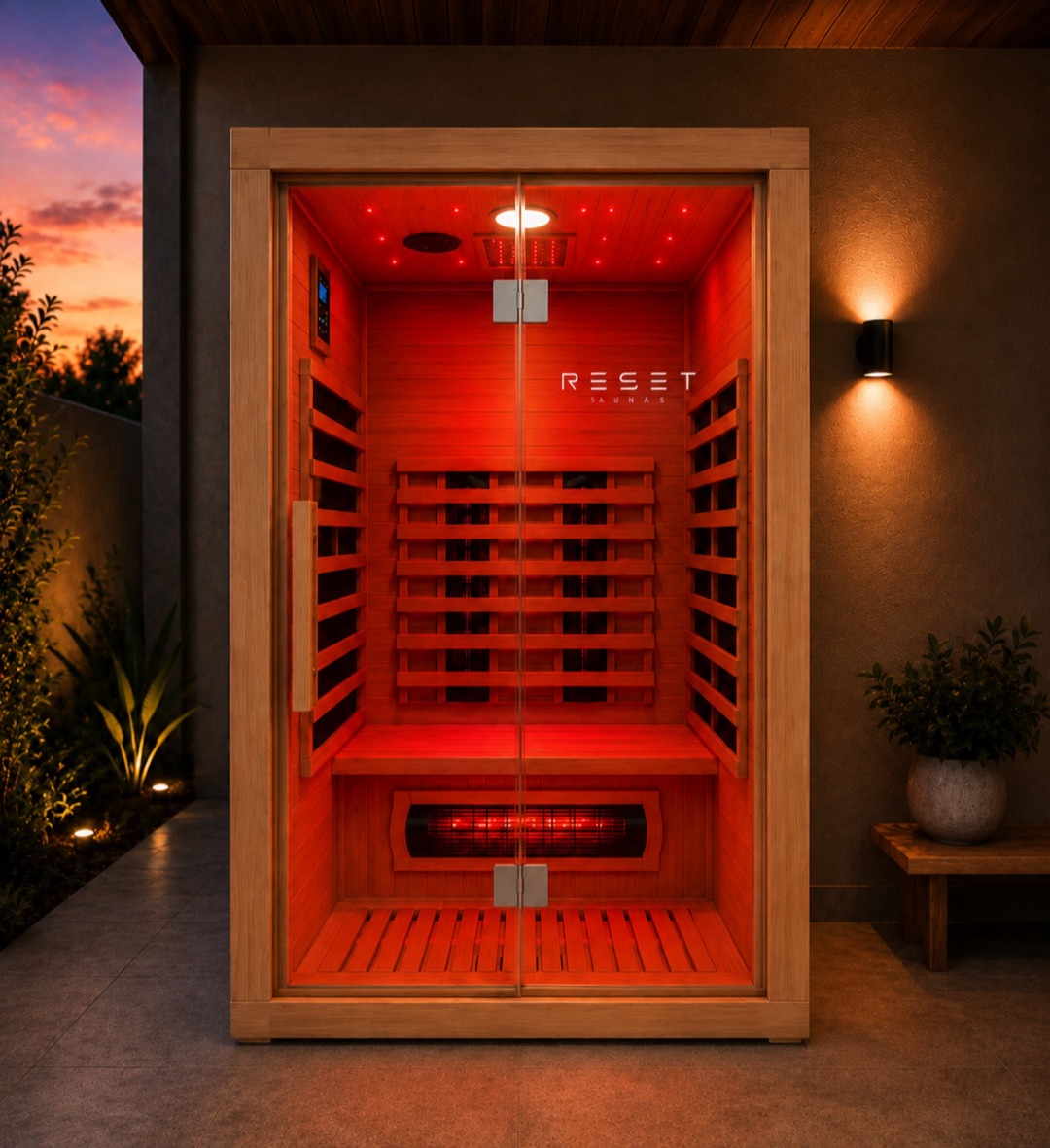
Why infrared

More than heat.

Infrared saunas work differently to the sauna at your local gym. Here's how — in plain language, without the hype.

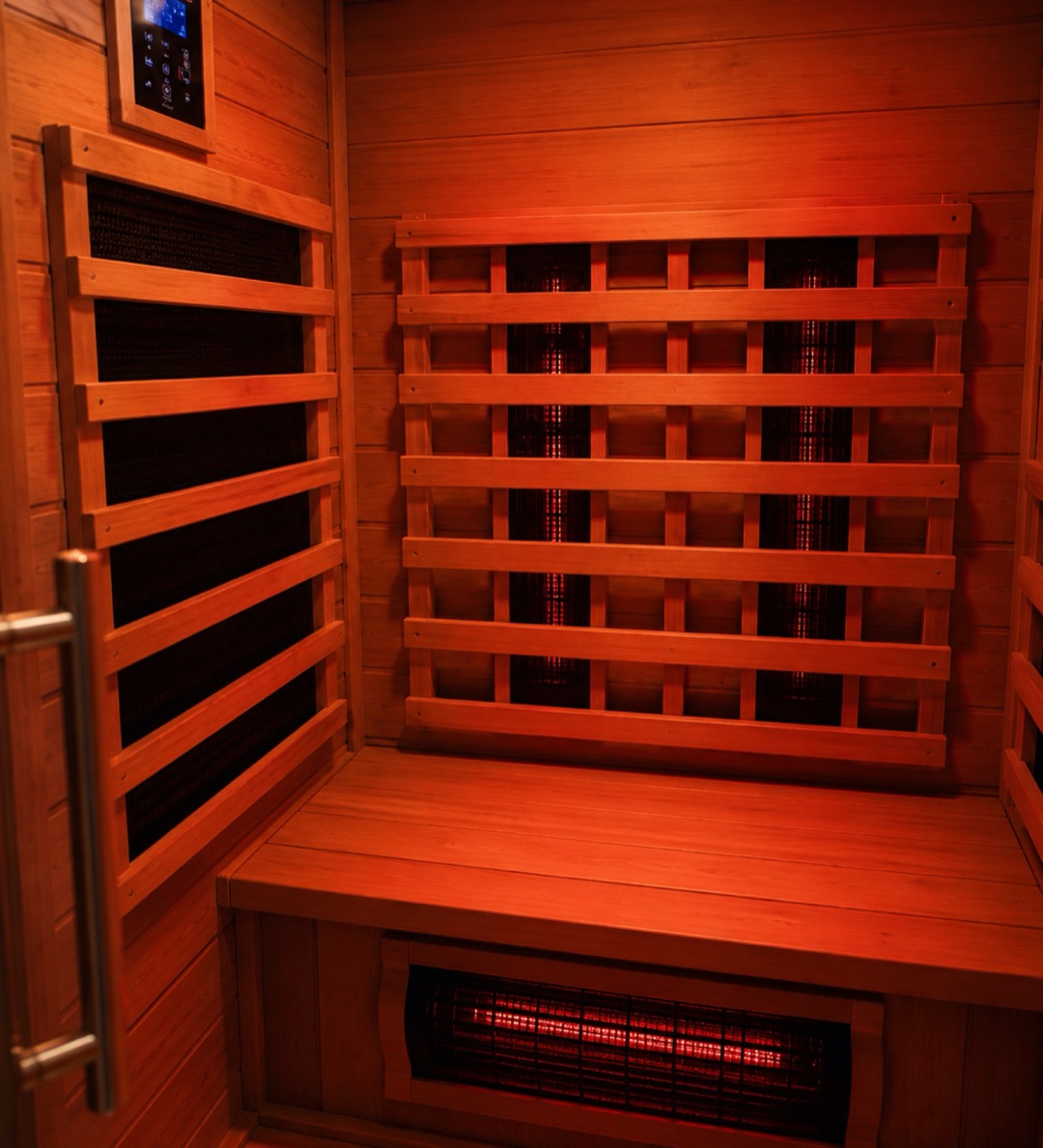
Infrared panels behind the cedar backrest of a Reset Origin

How it works

Warmth that reaches you directly.

A traditional sauna heats the air, and the air heats you. Infrared panels emit radiant heat that warms you directly, rather than heating the whole room first.

Reset's infrared saunas — Origin and Horizon — use full-spectrum heaters with low-EMF panels.

Full spectrum

Near. Mid. Far.

Infrared is a band of wavelengths just beyond visible red light. A full-spectrum heater covers all three parts of that band.

Near

The shortest infrared wavelengths, closest to visible light.

Mid

The middle of the infrared band.

Far

The longest wavelengths — the deep, radiant warmth most people associate with infrared.

Infrared vs traditional

Two ways to heat.

Both belong in a recovery routine. The right one depends on your space, your power supply and how you like your heat.

FeatureInfraredReset Origin · Reset HorizonTraditionalReset Summit
How it heatsFull-spectrum infrared panels warm you directly9kW stove heats volcanic stones — add water for steam
PowerStandard 10-amp plugTypically a 15-amp or hard-wired 240V circuit
Capacity2 or 3 people4–6 people
TimberCanadian Red Cedar (Origin)Solid Canadian Hemlock
From$3,790$9,400

The research

What the science says.

Plain-language summaries of the studies behind sauna bathing — who was studied, what kind of sauna, and what the results can and can't tell us.

01

Performance & recovery

  • Infrared
  • Randomised crossover trial

Faster bounce-back after strength training

After a heavy strength and plyometric session, athletes who spent 20 minutes in an infrared sauna recovered jump performance better and reported less muscle soreness than when they rested normally.

Who16 male basketball players

Keep in mind: A single session in a small group of trained men. A 2025 follow-up in 40 female athletes found regular post-training infrared use didn’t hold back strength or muscle gains, and may have helped power.

  • Traditional (~90°C)
  • Crossover study

Heat and endurance

Runners who added a post-training sauna for three weeks ran 32% longer before exhaustion at race pace, alongside a rise in blood plasma volume — estimated at around a 2% improvement in race time.

Who6 competitive male distance runners

Keep in mind: Very small study using a hot traditional sauna, not infrared.

Read the study

Scoon et al., Journal of Science and Medicine in Sport, 2007

02

Long-term health

20 years of Finnish sauna habits

A 20-year Finnish cohort study tracked over 2,300 men and found regular sauna use was associated with meaningfully lower mortality risk.

Source: Laukkanen et al., JAMA Internal Medicine (2015), KIHD 20-year Finnish cohort study of traditional Finnish sauna bathing. Reductions shown vs. once-weekly use. Associational data, not a guarantee of individual outcomes.

24%All-cause mortality risk reduction
27%Cardiovascular mortality risk reduction

Keep in mind: Observational research on traditional Finnish saunas in middle-aged men. It shows a link, not proof that sauna use caused the outcome.

03

Emerging research

  • Infrared (60°C)
  • Small clinical study

Daily infrared and blood-vessel function

Men with heart-disease risk factors used a 60°C infrared sauna for 15 minutes a day for two weeks. Their blood-vessel function improved towards that of healthy men.

Who25 men with at least one heart-disease risk factor, compared with 10 healthy men

Keep in mind: Short, small study in men with risk factors, run in a clinical setting. Each session was followed by 30 minutes resting under blankets.

Read the study

Imamura et al., Journal of the American College of Cardiology, 2001

  • Traditional
  • Controlled study

Regular sauna and the common cold

Over six months, adults who used a sauna regularly had fewer colds than those who didn’t — about half as many in the final three months. When they did catch a cold, it wasn’t shorter or milder.

Who50 adults (25 sauna, 25 control)

Keep in mind: An older, small study. It hasn’t been widely repeated.

Read the study

Ernst et al., Annals of Medicine, 1990

  • Medical heat device (not a sauna)
  • Randomised, sham-controlled trial

Why researchers are studying heat and mood

In a clinical trial, a single session of whole-body heating reduced symptoms for adults with major depression over the following six weeks, compared with a sham session.

Who34 adults diagnosed with major depressive disorder

Keep in mind: This used a medical device under clinical supervision, not a sauna. A sauna is no substitute for professional care — if you’re struggling, talk to your GP.

Read the study

Janssen et al., JAMA Psychiatry, 2016

This page summarises published research for general education. It isn't medical advice, and Reset saunas aren't medical devices. If you're pregnant or have a heart condition, low blood pressure or another medical condition, check with your GP before using a sauna.

The numbers

The recovery room math.

Recovery rooms charge around $50 a session. Most of the research above involves sessions several times a week. Here's what that would cost at a recovery room.

Cost per week$200
Cost per year$10,400

Reset Origin is $3,790, one time. You'd break even in under 5 months.

Arriving October

Meet Origin.

Full-spectrum infrared. Low-EMF panels. Plug in. Switch off.